
Should You Close Your Pool for Winter in North Texas? Why Most DFW Pools Stay Open
If you searched “winterize pool Texas,” here is the short…


In the mesh vs solid pool cover debate, the answer for most Dallas-Fort Worth pools is mesh. A Texas winter brings heavy rain, a handful of hard freezes and months of falling leaves, and a solid cover holds all of that water on top, which means a cover pump, more weight and more cleanup. A mesh cover lets rain drain through, keeps the leaves on top and works with a pool that stays open and circulating, which is how most DFW pools spend the winter. Solid covers still have a place, mainly when blocking sunlight is the top priority. Here is how the two compare on the things that matter in North Texas.
Key takeaways
A mesh pool cover is a woven or knit cover that lets water pass through while catching leaves and debris. A solid pool cover is a waterproof vinyl sheet that blocks water, debris and sunlight.
| Factor | Mesh cover | Solid cover |
|---|---|---|
| Rain | Drains through the mesh | Collects on top; needs a cover pump |
| Weight to handle | Lightweight; one person can roll it off | Heavy; often takes two or more people |
| Leaves | Stay on top, mostly dry; blow or brush off | Sit in a pond of water on top and must be pumped or scooped |
| Fine debris and pollen | Some fine particles pass through | Blocks nearly everything |
| Sunlight | Lets some light through | Blocks light |
| Freezes | Water drains, so less ice builds on the cover | Standing water can freeze into a heavy sheet |
| Best fit | Open pools that keep circulating | Pools that are fully closed or where light blocking matters most |
North Texas winters can be wet, and fall and spring storms can drop a lot of rain in a short time. A solid vinyl cover does not let water pass, so rain collects in the low spots and forms a puddle that grows with every storm unless a pump is running on the cover. Leaves land in that puddle and turn it into a brown soup that you have to drain before the cover comes off.
A mesh cover handles the same storm differently. Rain passes straight through the knit into the pool, so there is no pond on top and no cover pump to maintain. That drainage also matters for safety: standing water on any pool cover is a hazard for small children and pets, which is one more reason solid covers need constant pumping.
DFW typically sees freezes between late November and mid-March. The National Weather Service in Fort Worth lists the average first freeze as November 22 and the average last freeze as March 12. Most of those freezes are overnight events that thaw by afternoon, with an occasional long, hard freeze.
That freeze-thaw rhythm is rough on solid covers. Water sitting on top can freeze into a sheet of ice, adding weight and stress to the cover and its anchors, and cover pumps do not work in frozen water. With mesh, most water drains before it can freeze, so there is far less to deal with. Either way, do not try to pull a cover off while it is frozen. Let it thaw, then clear leaves and check the straps and anchors.
Remember that the cover is not what protects your plumbing in a freeze. Circulation is. Keep freeze protection on and the pump running through hard freezes no matter which cover you choose.

This is where DFW pools take the most punishment. Pecans and red oaks drop from late October through December, and live oaks shed again in late winter and spring. On a mesh cover, leaves sit on top of the knit, dry out and can be blown or brushed off. On a solid cover, they collect in the rainwater and steep, and you are pumping and scooping before every removal.
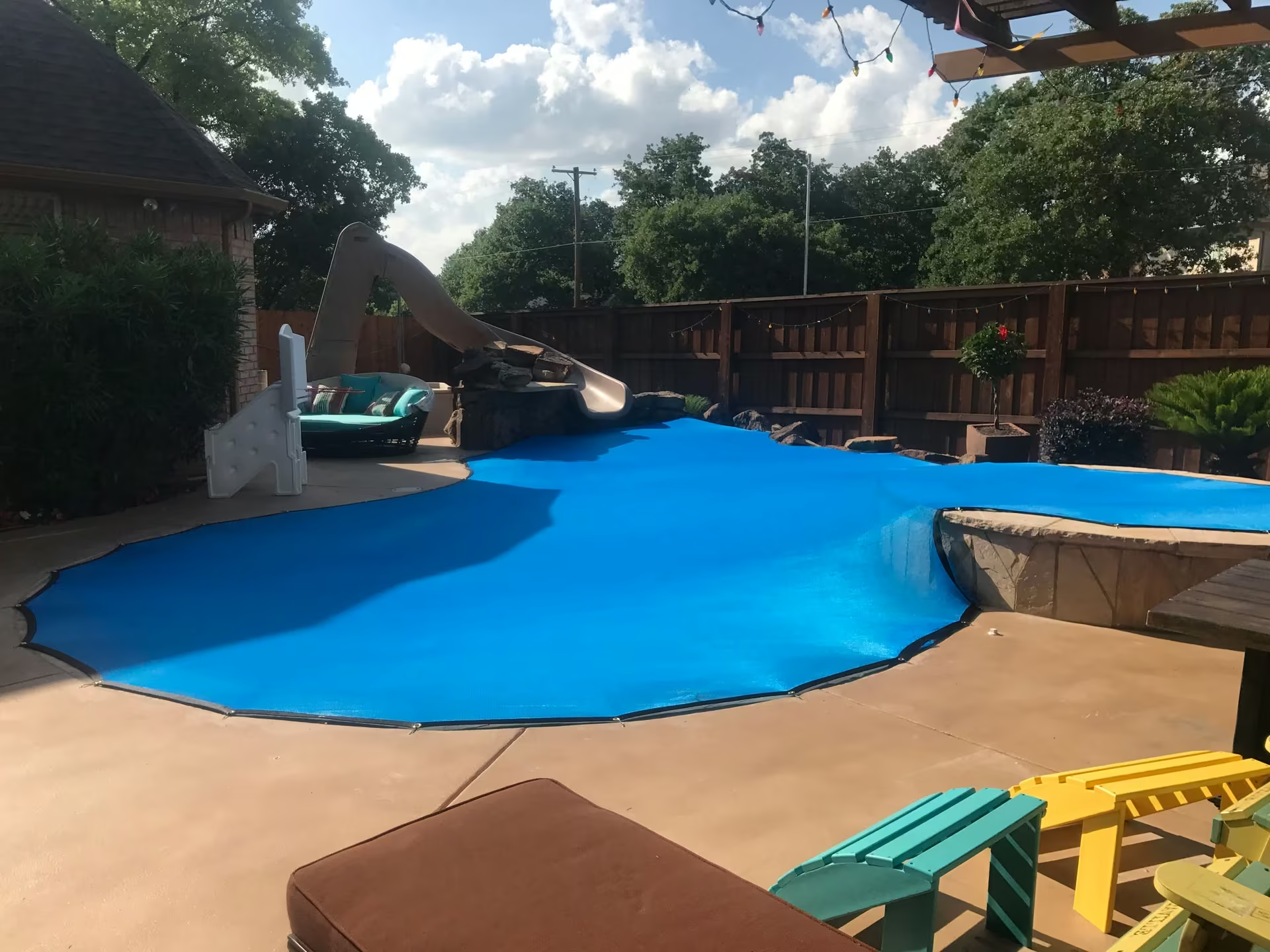
A custom mesh pool leaf cover is also lighter to handle. Our covers are high-density polyethylene mesh held by flush brass anchors, and most homeowners roll one off in 5 to 10 minutes and put it back in 10 to 20 minutes. A solid vinyl cover is heavy enough that it often takes two or more people to remove and install.
The main advantage of a solid cover is light blocking. With no sunlight reaching the water, algae has a hard time getting started, which is why solid covers are standard where pools are fully closed for months.
In North Texas, most pools stay open, circulating and sanitized through the winter, so light blocking matters less. A mesh cover does let some light in, but keeping sanitizer in range and the pump running on schedule handles that for an open pool. Mesh also keeps most of the leaves and debris out, and that organic material is a big part of what feeds winter algae when a warm spell arrives.
Mesh and solid describe the material, not whether a cover is a safety device. According to the U.S. Consumer Product Safety Commission’s Safety Barrier Guidelines for Residential Pools, safety covers should conform to ASTM F1346, the performance standard for pool safety covers, and they work as one layer of protection alongside fences, alarms and supervision.
Our mesh leaf covers are designed for debris, not drowning prevention. If you need a barrier for children or pets, look at a pool safety net, which meets ASTM F1346, or a removable mesh pool fence. Many DFW families pair a leaf cover with a safety net for both clean water and peace of mind.
Choose mesh if:
Consider solid if:
For a broader look at every cover type, including automatic covers, see our earlier guide to comparing pool cover options for North Texas pools.
For most DFW pools, mesh. It drains rain, keeps leaves on top, works with a pool that stays open and is light enough for one person to handle. Solid covers make more sense for pools that are fully closed.
Yes. Solid covers hold rainwater, so they need a cover pump to keep water from pooling on top. Standing water on a cover adds weight and is a hazard for small children and pets.
Some light passes through mesh, but an open pool with a running pump and balanced sanitizer usually stays clear. Keeping leaves out also removes much of what feeds algae.
Not automatically. Safety covers are tested to ASTM F1346. Our mesh leaf covers are for debris; our safety nets meet the safety standard.
Not sure which cover fits your pool? Book a free on-site assessment with Pool Leaf & Safety Covers. Call (214) 762-1804 or request a quote online.



Contact our local experts and discover how Pool Leaf & Safety Covers can protect your loved ones, reduce your pool maintenance, and transform your backyard experience.
